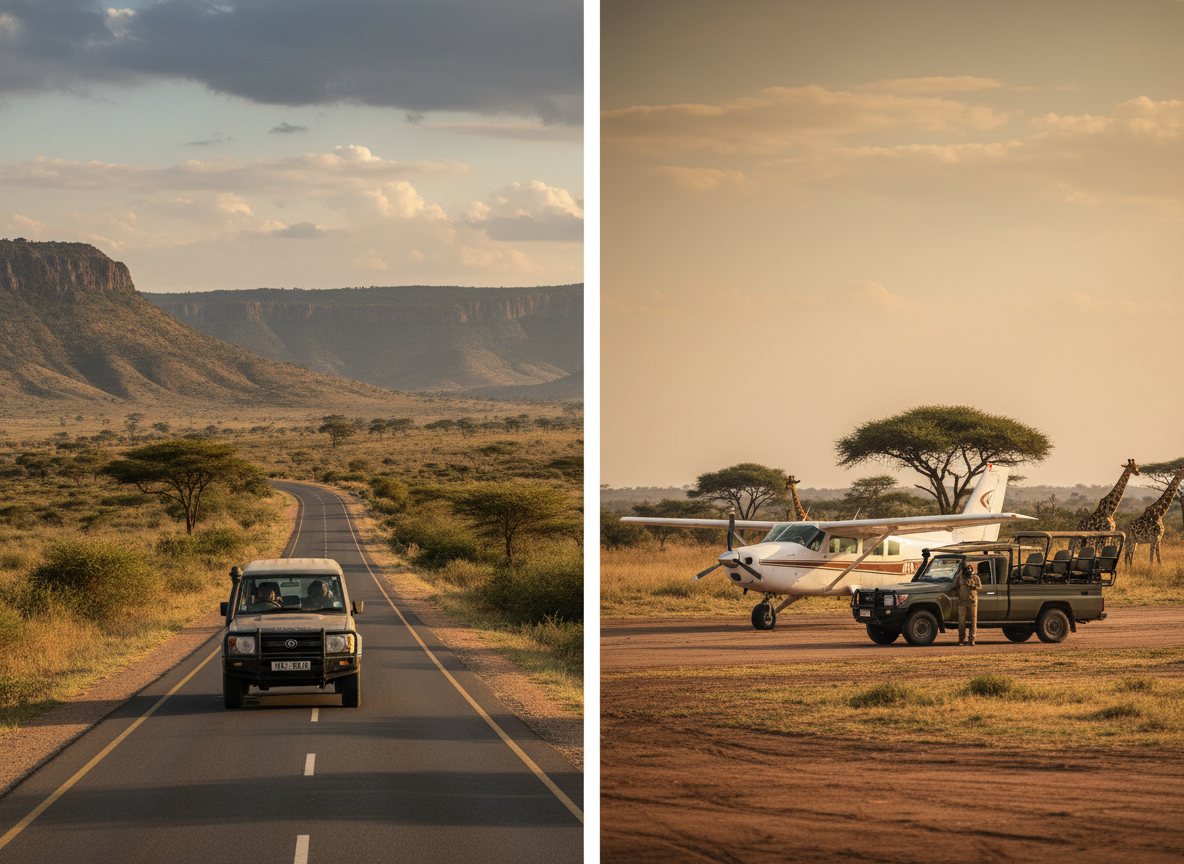
Planning a Kenya safari across more than one park raises an early and consequential question: how to get between them. The overland vs fly-in safari decision is a genuine trade-off, not a case of one option being clearly superior. Driving between parks gives you cultural immersion, routing flexibility, and lower transport costs. Flying saves hours, reduces physical fatigue, and makes a three- or four-park circuit achievable in the same number of days. Which approach works depends on how much time you have, what you want to see beyond the game reserves, and what you are prepared to spend on getting from one airstrip or gate to the next.
Kenya’s major parks spread across a wide geographic range, and most itineraries connect at least two. The choice of transport method becomes more consequential with each additional park.
The Overland vs Fly-In Safari at a Glance
| Factor | Overland | Fly-In |
|---|---|---|
| Travel method | 4×4 vehicle with driver-guide | Domestic aircraft between bush airstrips |
| Time per leg | 5 to 8 hours by road | 40 to 90 minutes by air |
| Transport cost | Lower (vehicle, fuel, guide shared) | Higher ($150-$500 per person per leg) |
| Parks in 10 days | 2 to 3 | 3 to 4 |
| Luggage allowance | No restriction | 15 kg soft bag per person |
| Physical comfort | Variable on rough tracks | High on short flights |
| Between-park experience | Rural Kenya, Rift Valley, local towns | Aerial views only |
The Overland Route: Ground-Level Kenya
What the Journey Looks Like
An overland safari puts you in a 4×4 with a driver-guide who navigates the route between parks. The Great Rift Valley escarpment, Maasai bomas, volcanic plains, and roadside markets pass by as the landscape shifts around you. A good driver-guide explains habitat transitions and points out roadside wildlife along the way; the drive becomes part of the experience rather than dead time between game drives.
A typical 10-day overland circuit might cover:
- Days 1 to 4: Masai Mara (roughly 5 to 7 hours from Nairobi)
- Days 4 to 6: Amboseli (6 to 8 hours via Nairobi or direct)
- Days 7 to 9: Tsavo East or Lake Nakuru (3 to 5 hours onward)
- Day 10: Return to Nairobi
Where Overland Works Well
- Cost control: No internal flight tickets; transport costs are shared across the vehicle and spread over the group
- Cultural depth: Rural Kenya between parks adds context that aerial travel skips: Maasai pastoral communities, agricultural zones, Rift Valley geology
- Routing flexibility: Itineraries can adjust mid-trip based on road conditions, wildlife reports from other guides, or changing preference
- No luggage limits: Hard-shell bags, tripods, and full photography kits travel without restriction
- Longer windows: Travelers with 12 to 14 days can absorb the drive time without feeling pressed
Where Overland Falls Short
- Time cost: A 7-hour road leg means arriving at the next camp tired, with an afternoon game drive immediately ahead
- Road conditions: Tracks inside Tsavo and Samburu are punishing; even good roads wear passengers down after several hours
- Seasonal access: Long rains close some routes or make them very difficult
- Park ceiling: Three parks in 10 days is realistic; four parks would mean near-constant transit
The Fly-In Route: More Parks, Less Road Time
What the Journey Looks Like
A fly-in safari connects parks via domestic carriers (Air Kenya, Safarilink, or private charter) landing at bush airstrips. A journey that takes 6 to 8 hours by road takes 40 to 90 minutes by air. You arrive at the next camp with the afternoon ahead and energy for a full game drive.
A typical 10-day fly-in circuit might run:
- Days 1 to 3: Samburu (about 60 minutes from Wilson Airport, Nairobi)
- Days 4 to 6: Masai Mara (roughly 30 minutes from Samburu)
- Days 7 to 8: Amboseli (about 40 minutes from the Mara)
- Days 9 to 10: Nairobi or onward
Guides at each camp specialize in their local ecosystem, so the wildlife knowledge builds with each stop rather than staying generalized across the whole circuit.
Where Fly-In Works Well
- Park coverage: Three to four parks in 10 days is achievable without burning entire days on road transfers
- Physical comfort: Short flights eliminate the fatigue of long, rough drives
- Remote access: Certain conservancy camps are fly-in only, with no road reaching them
- Aerial perspective: Low-altitude bush flights often pass over wildlife and striking landscape formations
- Compact timelines: Travelers with 7 to 10 days get far more hours inside parks than they would driving
Where Fly-In Falls Short
- Cost: Each internal flight runs $150 to $500 per person per leg; a three-leg circuit adds $900 to $1,500 per person before accommodation
- Luggage restrictions: Most bush aircraft enforce a strict 15 kg soft-bag-only limit; hard cases, camera rigs, and extra provisions all create problems
- Less between-park Kenya: The rural towns, pastoral land, and Rift Valley geology visible from the road pass unseen below the wing
- Schedule dependency: Flight connections tighten the itinerary; overland travel can pause, backtrack, or extend far more easily
Real Transport Costs: A Side-by-Side
10-day overland circuit (2 to 3 parks)
| Cost element | Estimate |
|---|---|
| Vehicle and driver-guide | $150 to $250 per day |
| Fuel for a 1,000 km circuit | $100 to $200 |
| Total ground transport | $1,600 to $2,700 for the group |
10-day fly-in circuit (3 to 4 parks)
| Cost element | Estimate per person |
|---|---|
| Three internal flights | $900 to $1,500 |
| Ground transfers at each end | $100 to $200 |
| Total air transport | $1,000 to $1,700 |
For a couple, fly-in transport typically costs $500 to $1,000 more than overland over a 10-day trip. For a group of four or more, the shared overland vehicle becomes progressively more competitive per person.
The Hybrid Option: Drive In, Fly Out
Many travelers split the approach. Driving from Nairobi to the Masai Mara captures the Rift Valley descent and rural Kenya on the opening leg. Then flying from the Mara to Amboseli or Samburu saves the hours that a longer cross-country road transfer would consume. The first leg delivers the overland experience; subsequent flights deliver the range. This structure works well for itineraries that want cultural immersion on the ground and broad park coverage without giving either one up entirely.
Explorer Notes
On luggage: The 15 kg soft-bag restriction on bush aircraft is firm on most carriers. If you are traveling with a telephoto lens, a second camera body, or more than a week of clothing, plan for overland transport or check baggage limits with your carrier before booking flights.
On timing: Seasonal rains affect overland routes more than fly-in. The long rains (April to May) can make tracks inside Tsavo and Samburu impassable; build schedule flexibility in if traveling during or just after the rains.
On first-time vs. repeat visitors: First-time visitors often benefit more from an overland leg; the landscape shift from Nairobi’s highlands through the Rift Valley and into the Mara provides context that enriches everything seen inside the parks. Repeat visitors who know the ground-level story tend to get more from the additional coverage that fly-in allows.
On group size: A private 4×4 costs the same whether two or six people share it, so overland savings scale with group size. Fly-in costs are per-person regardless, so larger groups gain no pricing advantage from flying.
Choosing the Approach That Fits the Trip
The overland vs fly-in safari question does not have a universal answer. It has the right answer for your available days, budget, and what kind of travel you find rewarding. First-time visitors with two weeks and an interest in Kenya beyond the game reserves tend to get more from overland travel. The cultural and geographic texture built up over road transfers enriches everything they observe inside the parks. Travelers with a week, families with young children, or anyone who has already covered Kenya by road often find the premium for fly-in worth paying for the additional time and energy it preserves.
The hybrid structure (one overland leg followed by one or two flights) is worth considering when neither extreme fits. Most itineraries end up somewhere between the two, shaped by available days and which parks are on the list.
Prefer a different route, budget, or travel style? This plan can be adapted to fit.
Customise Your Trip